

Latest updates on country situation
22 July 2026
Food insecurity is projected to deteriorate, with the number of people facing Crisis (IPC Phase 3) or worse increasing by approximately 75%, from 2.12 million between June–September 2026 to 3.72 million between October 2026 and February 2027. Those in Emergency (IPC Phase 4) are increasing by 133%. This deterioration is driven by the lean season, depleted food stocks, high prices, cyclone impacts, and El Niño-related climate risks. (IPC accessed 21/07/2026, MM 06/07/2026)
16 February 2026
On 11 February 2026, Cyclone Gezani passed through Madagascar, affecting Alaotra Mangoro, Analamanga, Analanjirofo, Est, and Itasy regions and 25 districts. By 16 February, the impact had affected nearly 424,000 people including 16,000 displaced, some of whom are sheltering in 48 accommodation sites. Reports indicate 59 fatalities, 804 injuries, and 15 missing people. Gezani’s impacts are those of Cyclone Fytia, which recently caused widespread flooding and agricultural losses, further weakening household resilience and recovery capacity. Infrastructure damage from Gezani is extensive, submerging over 27,000 houses, destroying 25,000, and damaging 49,000. It also affected 781 schools (563 lost roofs, 142 were partially destroyed, and 76 were demolished) and damaged two hospitals. Flooded roads, damaged infrastructure, and disrupted communications restrict access to affected communities, particularly in areas accessible only by air. Forecasts indicate possible additional coastal impacts with a potential southward shift. Priority needs include emergency shelter, food assistance, NFIs, WASH, and health services. (BNGRC Facebook 16/02/2026, IFRC 13/02/2026, News.Az 16/02/2026)
03 February 2026
Tropical Cyclone Fytia made landfall on 31 January 2026 near Soalala in northwestern Madagascar, bringing intense rainfall, flooding, and heavy winds that affected surrounding districts, including Mitsinjo and Marovoay (Betsiboka region), as well as central areas such as Antananarivo and parts of the eastern coast. The cyclone severely disrupted access, with Soalala and Mitsinjo accessible only by air given inundated roads and damaged infrastructure, including bridges and communication networks. By 2 February, nearly 61,000 people were affected, with over 19,000 displaced and sheltering in temporary structures across affected regions. Housing losses were extensive, with more than 10,800 houses flooded, 1,400 damaged, and 1,700 completely destroyed, alongside seven deaths, one missing, and seven injured. Assessments continue, with priority needs including food, clean water, and medical supplies for displaced and isolated communities. (OCHA 02/02/2026, BTB 02/02/2026, BNGRC 02/02/2026)
02 February 2026
Between December 2025 and January 2026, 1.57 million people in Madagascar faced Crisis (IPC Phase 3) or worse, including 84,000 in Emergency (IPC Phase 4) levels, mainly in the south and southeast as a result of climatic shocks, reduced aid, and sociopolitical instability. For February–April 2026, food insecurity is projected to reach 1.8 million, including 71,000 in IPC 4, driven by cyclone and flood risks, access constraints, and health pressures. (IPC 29/01/2026; IPC 09/09/2025)
09 September 2025
In Madagascar, food insecurity is expected to worsen as a result of poor harvests driven by climatic shocks and pest and disease attacks, alongside unemployment, high food prices, and inadequate WASH conditions. From May–September 2025, approximately 1.2 million people are projected to experience acute food insecurity of Crisis (IPC Phase 3) or worse levels, with the number rising to 1.5 million by January 2026 and reaching 1.64 million by April 2026. From May 2025 to April 2026, acute malnutrition is expected to affect around 558,000 children and 38,500 pregnant or breastfeeding women. (IPC 09/09/2025, IPC 09/09/2025)
18 March 2025
Tropical Storm Jude made landfall in Madagascar on 8 and 15 March, affecting the Grand Sud regions. The storm brought heavy rainfall, causing fatalities and damage to homes, schools, and roads and hindering humanitarian access. At least 15,000 people were affected, with over 10,000 displaced to temporary sites. Urgent needs include food, WASH, protection, and healthcare.
(OCHA 18/03/2025, ECHO 17/03/2025)
04 March 2025
On 2 March 2025, Cyclone Honde passed near southwestern Madagascar, displacing around 22,000 people, killing three, and injuring 69. It also damaged houses, schools, and roads. By 4 March, those displaced were staying in temporary shelters across districts. Their most urgent needs include food and NFIs, WASH, and medicine. (OCHA 04/03/2025, Lexpress 04/03/2025)
current crises
in
Madagascar
These crises have been identified through the INFORM Severity Index, a tool for measuring and comparing the severity of humanitarian crises globally.
MDG001 - Multiple Crises
Last updated 30/06/2026
Drivers
Drought/drier conditions
Cyclone
Crisis level
Country
Severity level
6.2 High
Access constraints
3.0
MDG002 - Drought in Southern regions
Last updated 27/08/2026
Drivers
Drought/drier conditions
Crisis level
Country
Severity level
6 Medium
Access constraints
2.0
Active risks
Analysis products
on
Madagascar
13 February 2026
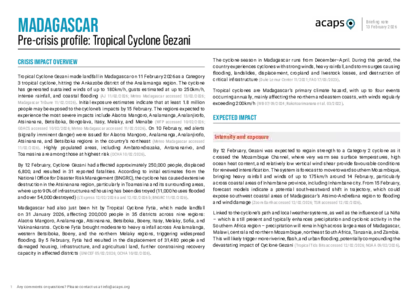
Madagascar: Pre-crisis profile - Tropical Cyclone Gezani
DOCUMENT / PDF / 421 KB
Tropical Cyclone Gezani made landfall in Madagascar on 11 February 2026 as a Category 3 tropical cyclone, hitting the Ankazobe district of the Analamanga region. The cyclone has generated sustained winds of up to 180km/h, gusts estimated at up to 250km/h, intense rainfall, and coastal flooding.
05 April 2024
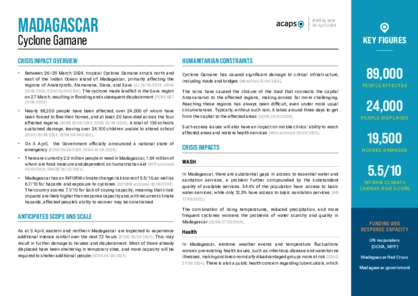
Madagascar: Cyclone Gamane
DOCUMENT / PDF / 404 KB
Between 26–29 March 2024, tropical Cyclone Gamane struck north and east of the Indian Ocean island of Madagascar, primarily affecting the regions of Analanjirofo, Atsinanana, Diana, and Sava. Nearly 88,200 people have been affected, over 24,000 of whom have been forced to flee their homes.
19 January 2024
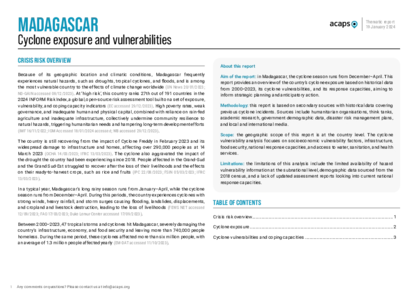
Madagascar: cyclone exposure and vulnerabilities
DOCUMENT / PDF / 861 KB
This report provides an overview of the country’s cyclone exposure based on historical data from 2000–2023, its cyclone vulnerabilities, and its response capacities, aiming to inform strategic planning and anticipatory action.
22 February 2023
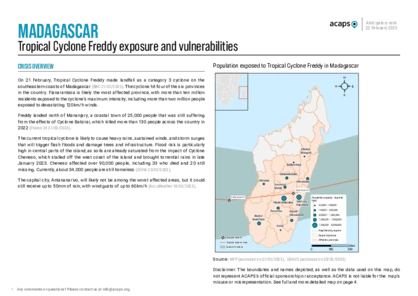
Madagascar: Tropical Cyclone Freddy exposure and vulnerabilities
DOCUMENT / PDF / 4 MB
The report aims to provide a brief overview of the key regions exposed to Tropical Cyclone Freddy and highlight existing vulnerabilities that might increase the needs of the exposed population.
10 March 2022
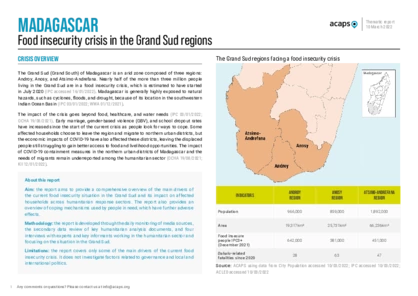
Madagascar: Food insecurity crisis in the Grand Sud regions
DOCUMENT / PDF / 575 KB
The report aims to provide a comprehensive overview of the main drivers of the current food insecurity situation in the Grand Sud and its impact on affected households across humanitarian response sectors. The report also provides an overview of coping mechanisms used by people in need, which have further adverse effects.